
CTR (Click Through Rate) is a metric to measure the ratio between the users who clicked on the hyperlink to the total number of people who saw the hyperlink.
It is used in SEO to measure how many people clicked on the snippet of your page in the SERP.
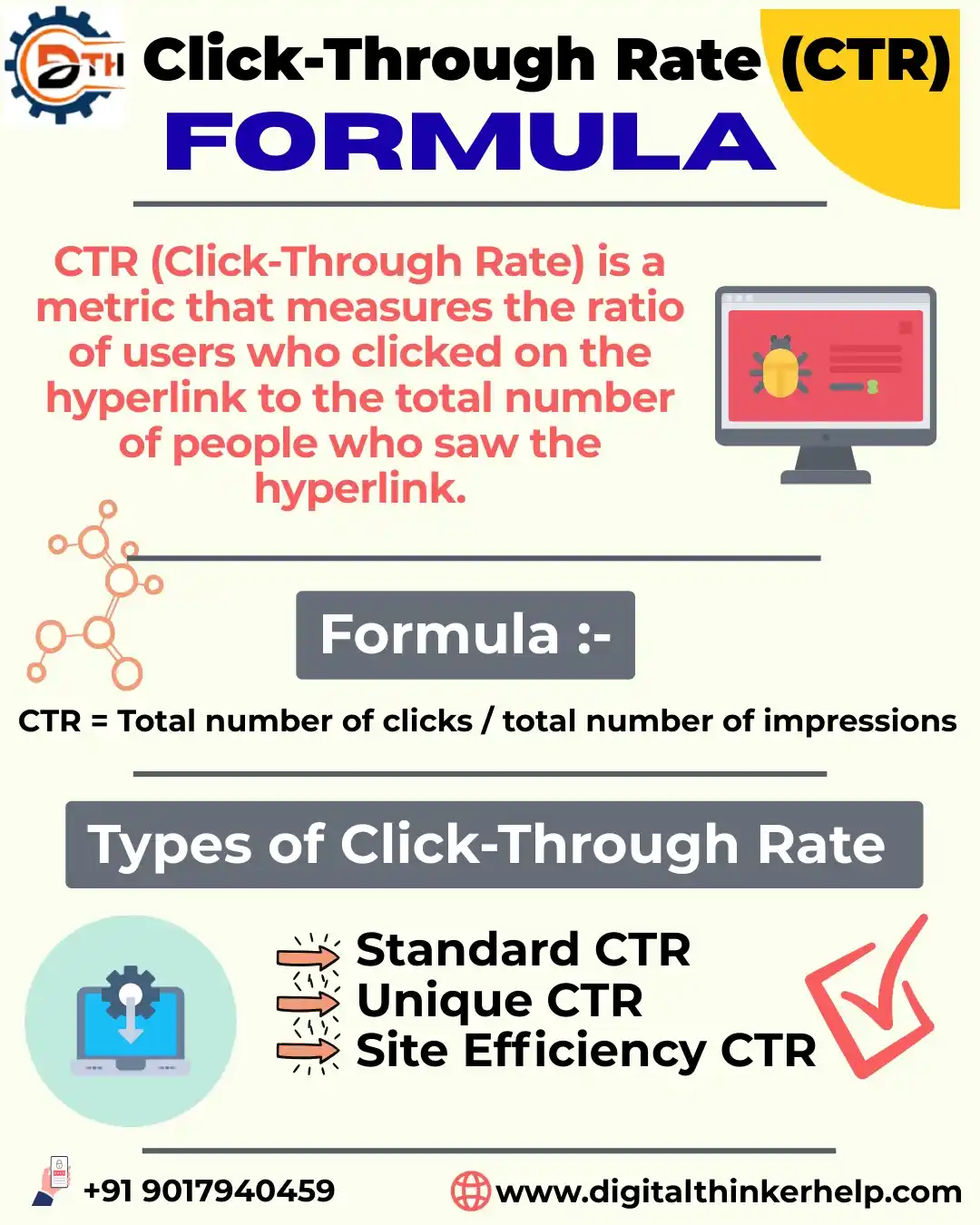
In this guide, we will explain what click-through rate is. We will show you how to calculate CTR and what are the strategies to help you improve this crucial metric. We will also explain how CTR enables you to make informed decisions about your product.
Why Click Through Rate Is Important?
If you want to evaluate the success of digital ads, content and online marketing campaigns Click-through Rate is a important metric. If an ad effectively captures audience attention and encourages engagement are indicates a high CTR and it also provide the crucial validation for advertising strategies.
It helps to allocate resources where they yield the most return and it directly impacts budget decisions. Moreover to measure how well different campaigns perform at various stages of the customer journey. CTR helps in assessing the effectiveness of marketing efforts.
Also Read: What is Bounce Rate in SEO? How to Reduce & Check It?
Click-through Rate works like a universal metric for various channels and campaign types. It also searches ad and other PPC ad campaigns, social media posts, emails, and more.
Your online ads have visuals, text or a call-to-action is actually getting the attention of people or not. CTR basically is critical for accessing the efficacy of advertising creative and tells you that your message is landing or not.
A high CTR is essential for both performance optimization and creative fine-tuning and it is not just the success of a campaign but the quality of its components.
How to Calculate CTR? With Example
You can calculate CTR by divide the number of clicks on your ad or page receives by the number of times the asset is shown to the customer.
Calculate CTR using formula:
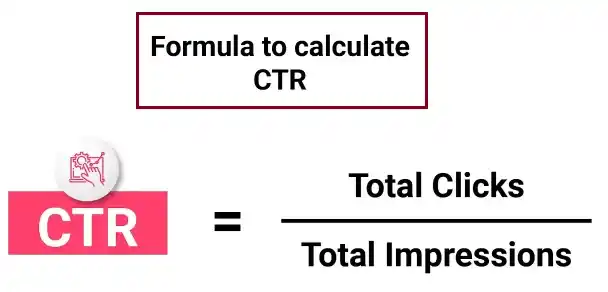
CTR = Total number of clicks / total number of impressions
Where: The total numbers of users who clicked on the ads/listing/emails is the total number of clicks. For an example in an email campaign total number of clicks refers to the total number of people who opened the email.
The total number of users who viewed the specific link-related ads/listing/emails is the total number of impressions. For an example in an email campaign the total number of impressions is the total number of email recipients.
Also Read: What are Core Web Vitals? How to Improve & Fix Them
Let’s discuss an easy example that shows how CTR calculation works. In case you get 8 clicks and 100 impressions on an ad then the CTR would be 8%.
8 / 100 = 0.08
The important part of CTR is keywords that make helps to rank the ads. A high CTR always shows that customers see your ads and listings and find them helpful. It makes sure that the user will click the ads.
CTR can be measured with these simple examples:
A call-to-action link
A hyperlink on the landing page
Pay-per-click (PPC) ad on Google search results
An ad/display on social media or websites
Types of Click-Through Rate (CTR)
There are different platforms have developed their own versions of CTR as digital marketing has grown are:
Standard CTR: This is the basic formula we discussed above that the total number of times an ad is shown or clicked.
Unique CTR: It compared and measures mainly that how many unique users individually click and how many see the ad. This is beneficial for the platforms like Meta (formerly Facebook) where users can see the same ad multiple times.
Site Efficiency CTR: It measures how your website content effectively convinces people to do actions.
Unique Link Clicks Vs. All Link Clicks
There are two ways to track these individual link clicks even though the most top part of your equation represents how many times your audience clicks through a particular email campaign.
Unique link clicks: As a result that the CTR will tell you what percent of recipients clicked through an email. Track once for each user that clicks through a link.
Also Read: What is Cumulative Layout Shift (CLS)? How to Fix & Check
All link clicks: Basically the CTR tells you the ratio of “emails sent” to “visits to your site.” Even if the same user clicks through multiple times that counts any click through an email.
What is a Good Average CTR?
It may vary from one company to another company that what counts as a good CTR. For an example if there are two ecommerce business companies A and B, both are running the campaigns of online advertising.
Company A is fighting with so many brands for attention in a very competitive industry and getting the CTR of 2% actually a good score. On the other hand company B is achieving the CTR of 5% with competing in a niche market and less completion is actually effective targeting.
You can continuously monitor measure and improve the performance of your campaigns by using the key for your own historical CTR as a benchmark.
Also Read: What is Largest Contentful Paint (LCP)? How to Improve it
Tracking the CTR on monthly basis helps the business leaders and marketers to monitor fluctuations and understand the causes of increases or decreases.
It helps them to drive better results by tracking CTR enables them to make informed campaign decisions.
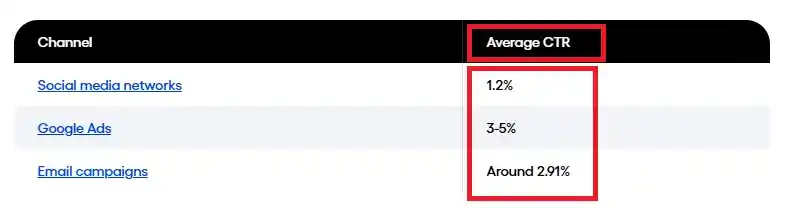
Well there is no need to worry about the exact numbers. Let’s take an example if your CTR is below to the average but still it is slightly improving. We would like to recommend instead of meeting the industry averages you should continue to focus on making continuous improvements.
What Does the Click-Through Rate Tell You?
Now we will discuss how the Click-Through Rate (CTR ) is like a digital meter for your content:
Engagement Level: CTR represents the ratio between the persons who noticed your links and those who clicked on them. If the CTR is greater than it shows the greater engagement of people to find your material interesting and motivated to take action.
Content Effectiveness: It helps you to evaluating how much your content will get people to interact. While a low CTR shows that your content need the improvement.
Also Read: What Is Interaction to Next Paint (INP)? How to Optimize It
Audience Interest: CTR gives you the information about your audience interests. A greater CTR for specific subjects or content categories shows the interest of your audience.
Ad Performance: CTR is very important for online advertisements. It shows that how good the advertisement is working and whether your target audience is responding to it or not.
Campaign Success: It is important marketing measurement. It helps to know about how well your efforts are improving user engagement and conversions.
How to Check CTR (Click Through Rate)?
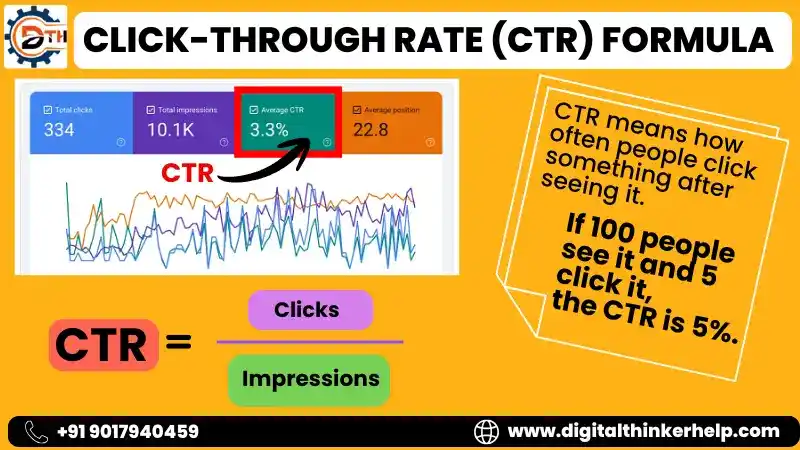
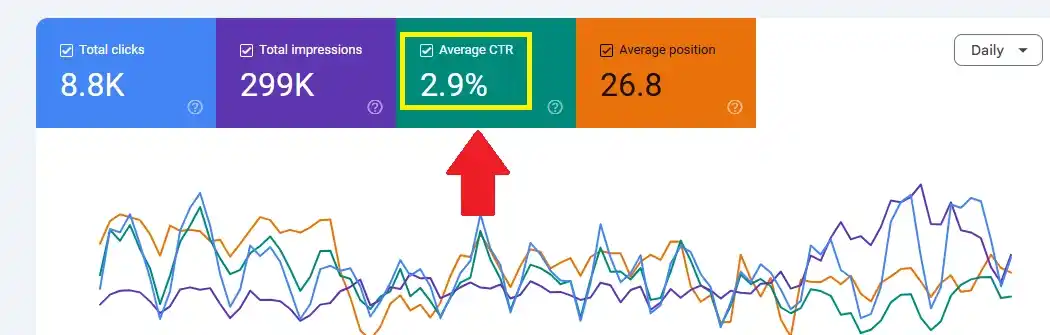
It is most easiest and common way to know the performance of your pages. You can check the CTR in Google Search Console.
Here, you can see the performance report to an average of all the CTR values for all the pages and all the queries that ranked for is the default CTR value. Always specify the page and the query to get the most relevant results for your analysis.
There are the steps to check the average CTR of your individual webpages in Search Console:
- Go to the Search results section
- Select the Average CTR metric above the Performance chart
- Mention the Date range if you want to check the CTR of your pages
- Select the Pages tab under the chart
- Find and check specific pages with their average CTR
- Select query
There are filters also can be used to see only those pages that fall under certain CTR range.
Final Thoughts
Click-Through rates shows you exactly what your customers are interested in and engaged with are not like general impressions. You must be sure to listen to that.
Also Read: What is Service Schema? Examples & How to Add
You can generate more clicks, more revenue and a better customer experience when you listen, learn and respond to what your audience is already telling you.