
The Google Panda algorithm is one of the famous technical SEO updates to Google’s search engine history.
It was introduced in February 2011. The aim of Google Panda algorithm is to improve the search results by demoting the low-quality websites and content. Always this content was creating by the large-scale content farms.
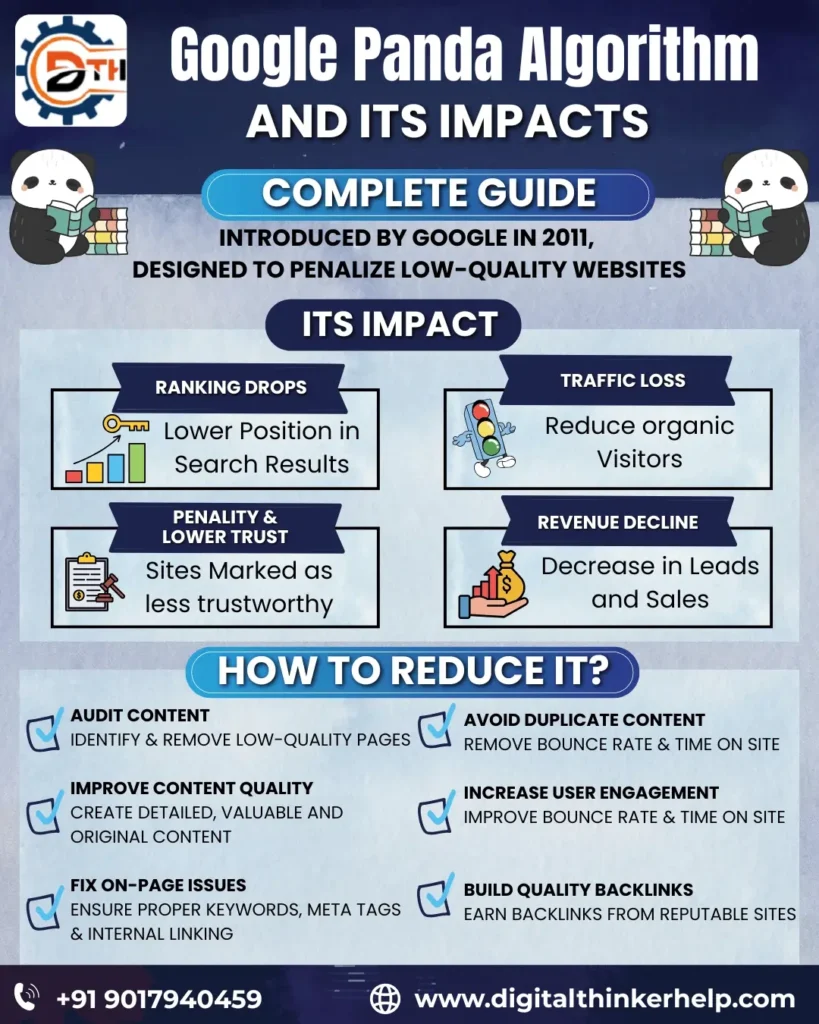
The sites with copied or duplicate content were likely to see their rankings go down according to the algorithm of Google Panda. These sites also had advertising. On the hand high-quality sites that offered original, relevant and valuable content were rewarding with higher rankings. This improved the user experience.
In this blog our team of experts will tell you about the Google Panda algorithm. We will cover the who, what and why of the Google Panda algorithm. You will get everything you need to know about this update.
When Was The First Google Panda Update?
The first Google Panda update was getting to roll out on February 23 2011 in the USA for Google search. The update started on April 11th, 2011 for all English-language search queries.
The Google Panda algorithm was implementing globally for all languages except Korean, Chinese and Japanese on August 12th, 2011. According to Google 12 percent of all search queries were affected by the Google Panda update.
Also Read: What is Share of Voice SEO? How to Calculate & Measure It
In the week after the Google Panda update there were big effects for SEOs worldwide. Content farms and websites with content were impacted. For example websites that only accumulated content were affected. Some sites lost than 80 percent in visibility in 2011.
Google Panda Algorithm Update Impact on SEO- Analysis
The Google Panda updates have impacted SEO. They appreciate white hat SEO practices with rankings and eliminate black hat SEO. Let’s review the points to comprehend the Google Panda updates impacts on SEO.
Poor Grammar and Incorrect Spelling – The Google Panda update enables Google to identify content with misspelled and poor grammar and block them from getting visibility. A blog post can’t get ranking anymore if there is any spelling mistakes or incorrect grammar. The algorithm of Google panda makes grammar and spelling an essential part of SEO.
Keyword Stuffing –The Google Panda update blocks spammer’s websites keyword stuffing tactic to get a ranking on SERPs. The artificial keyword stuffing that makes the content complex enough to read and comprehend can be identifying easily by Google panda. So, keyword stuffing becomes a negative SEO signal after the panda update.
Thin Content – Content volume matters after the Google Panda update. Thin content can’t get ranking anymore. According to panda update there is no space for thin and poor quality content. So it is necessary to write comprehensive article with adequate information to win higher SERP rankings.
Website User Experience – The Google Panda algorithm accesses the content quality. Scrutinizes the website UX. Website UX is an important SEO factor after the panda update. Collaboration of content writers and web developers is must to deliver the best user experience.
How Does Google Panda Algorithm Work?
Recognizing content and low-quality websites is easy for users. For search engines it’s a tough process. This is especially true on the diverse web. Amit Singhal, the Vice President of Search at Google told wired magazine that solving this issue had to be doing in a scientific way.
Also Read: Voice Search SEO and its How to Apply Voice SEO with Example?
Google researchers then came up with a set of questions for website testers. These questions helped review a selection of domains. From these questions and reviews the Google team created a set of signals. These signals defined what would be considering low-quality content, on Google.
Google keeps changing and improving the signals and metrics it uses. This helps Google determine a websites value. It enables Google to stay updated on what are good and bad content. This way Google can continuously provide a user experience.
Recovering Rankings After Google Panda Penalty
The Google Panda algorithm often mentions as an update from which a site can be resumed with difficulty. However the road to recovery is rather simple. You need to increase the quality and uniqueness of the content and the site.
Also Read: Doorway Pages in Seo and its Types, Examples, & Google Spam Policies

There are some actions need to take to recover rankings you need to:
Abandon content farming practices.
As it understood that review the sites content for quality, utility, relevance, reliability and authoritativeness.
Pages should not be dominating by ads or affiliate links so review the ad/content rate or affiliation/content.
Guaranteed and ensure the content is relevant to the query of users.
Remove orrevise the duplicate content.
Control and edit user-generated content. Make sure that it is original, error-free and useful to readers.
Block the indexing of internal contents of your site that could be duplicate, almost duplicate or otherwise problematic. Use the no index or no follow robot commands to avoid it.
Best Practices for Avoiding Google Panda UpdateHit
You need to focus on creating content that helps the users to avoid being penalized by Google’s Panda update. Your website meets the standards of Google here are some tips to make sure:
Produce Original content: Always be sure that your content is not copied from other websites. This helps your site stand out from low-quality sites. Your site doesn’t have low-quality content farms and differentiate it with its originality.
Enhance Content Depth and Relevance: Make your content in detail and relevant. Give users useful information that answers their queries perfectly. You should not even create the content that is thin and lacks substance.
Optimize User Experience: First thing is your website should be user-friendly. Your website design should look good and easy to navigate. Make sure it includes the loading of pages quickly and works on devices such as mobile.
Maintain a Balanced Ad-to-Content Ratio: The best thing is not overdo it with ads. Always keep maintain a balance between ads and content. This way makes the users can focus on your content.
Also Read: What is Cloaking in Seo? Types & Risks | How to Work It
Regularly Update Content:Update your content on regular basis. Keep updating regularly make your content fresh and relevant. This keeps users engaged. Tells search engines that your site is active.
Improve User-Generated Content:Improve the content created by users. Watch over content created by users on your site and make sure it is good. Encourage users to contribute content.
Establish Authority and Trust:You can create your content from credible experts and link to authoritative references to build authority of your site. It improves the trust of both users and search engines.
Use SEO Best Practices:Use the SEO strategies that are recommended by Google. This includes some guidelines of Google like using keywords in a natural way, optimizing tags and having a site structure.
You can protect your website from Panda penalties by following these tips and improve your search engine rankings. Focus, on giving users content and a positive experience to build a reputable online presence.
FAQs (Frequently Asked Questions)
Verdict Up
The Google Panda algorithm update was a change in SEO. It emphasized content quality and user experience. How websites are ranked now it is reshaped by the Google Panda algorithm.
Also Read: What is Cost Per Click (CPC)? How to Calculate with Formula
It supports the creation of high-quality content and more user-friendly sites. The principles established by the Google Panda algorithm is most important to understanding and adapting for maintaining search engine performance.