
Core Web Vitals were introduced six years ago. Is it surprising for you, right?
It is just like other Google tools Core Web Vitals keep changing and improving over the time.
As it means for you that the rules are not fixed for making your website fast, smooth and user-friendly. It is important to be updating and adjust your site regularly to meet Google’s latest standards.
We’ve rounded up some newer, lesser-known optimization strategies that can help you break into the 47% of sites that currently pass their Core Web Vitals assessment in these lines.
What Are Core Web Vitals?
Google’s Core Web Vitals are a set of three metrics that measure how users experience a webpage.
These are the main part of Google’s page experience. It can play a role in how a page performs in search rankings.
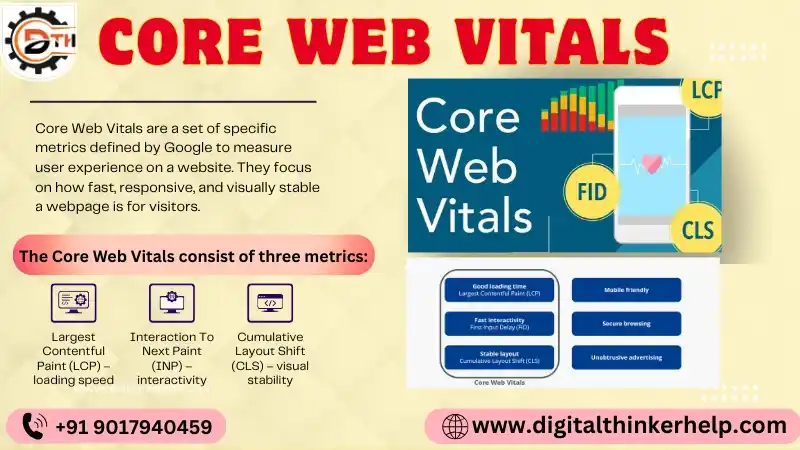
The Core Web Vitals consist of three metrics:
LCP: Largest Contentful Paint (LCP) – loading speed
INP: Interaction To Next Paint (INP) – interactivity
CLS: Cumulative Layout Shift (CLS) – visual stability
The biggest benefit is more sales. About 70% of shoppers say page speed affects whether they buy something online and even a tiny 0.1-second speed boost can increase sales by over 8%.
Core Web Vitals Scores
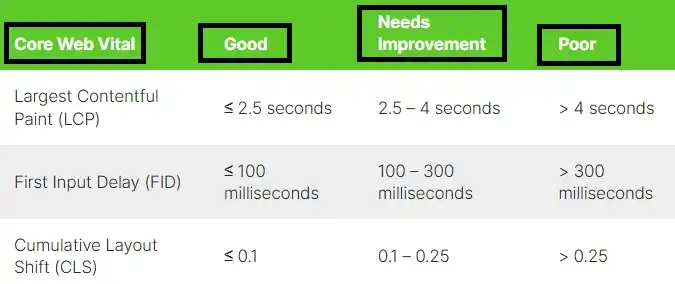
Core Web Vitals scores usually measures as ‘Good’, ‘Needs Improvement’ and ‘Poor’. You can see it below in the image.
Why Are the Core Web Vitals (CWV) Important?
Strong Core Web Vitals improves your SEO by a smoother, faster and more stable experience for users.
Usually most of the people are like to stick around and even convert on a site that loads quickly and responds right away. That is why faster sites usually see lower bounce rates.
Google also factors the Core Web Vitals into its rankings.
Basically by improving them can boost your visibility in search results and bring more traffic on your site.
Core Web Vitals metrics & Types
Here, we will discuss about the 3 current Core Web Vitals metrics that each one designed to measure:
Largest Contentful Paint (LCP) – Loading
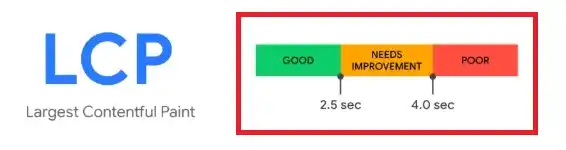
Largest Contentful Paint does measure that how fast the main content of your page will load.
As we discussed the LCP element is the largest single piece of meaningful content that appears on the visible part of the screen. “Contentful” means it’s not just any element.
It has to be something important like an image, a block of text or a video that’s visible in the viewport when the user first lands on the page. When measuring the LCP only these types of elements are considered.
Largest Contentful Paint (LCP) measures the time in milliseconds and how long it takes from when a user opens a page until the biggest visible piece of content is fully displayed on the screen and above the fold.
Largest Contentful Paint depends on the experience of user that is why it was chosen. When the LCP happens a visitor usually feels the page has loaded — even if it’s not fully complete. LCP created to answer the question: “When is the main content of a page visible to the user?”
Interaction to Next Paint (INP) – Interactivity
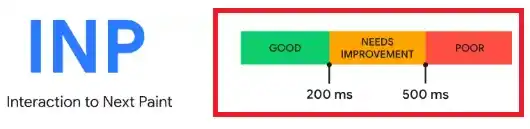
Interaction to Next Paint (INP) measures your site’s interactivity. INP basically shows that how fast the browser responds and updates the page layout after a user interacts with it.
The Interaction to Next Paint (INP) value is the time between a user interaction and the page’s final visual response. The slowest interaction (or the 98th percentile of all interactions) is what determines the overall INP score for the page.
INP is a real-user metric, so it can’t be measuring in lab tools like Lighthouse — it needs actual user interactions. In Lighthouse, the Total Blocking Time (TBT) metric correlates fairly well with INP. While INP is usually much lower than TBT, improving your TBT will generally help improve your INP too.
Cumulative Layout Shift (CLS) – Visual stability
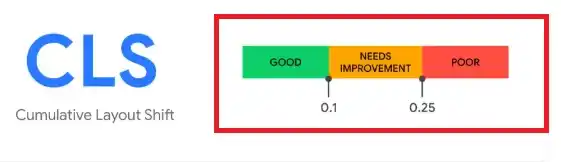
Cumulative Layout Shift do measures the visual stability of a page as a Core Web Vitals metrics. It tracks unexpected shifts of elements on the screen as content loads or new elements appear which can disrupt the user’s experience.
The CLS value gets calculation using two factors: the ‘impact fraction’ and the ‘distance fraction’. When an element moves unexpectedly it shifts the other content around.
The distance fraction can be measuring about how far the element moved relative to the viewport. But, if talk about the impact fraction, and then it measures how much of the viewport is affecting by the shift.
How to Improve Core Web Vitals? Fix it
Core Web Vitals always keep changing. That is why improving them isn’t something you do only one time. To stay ahead, websites should make page speed optimization part of their regular work flow monitor performance often and keep making small and steady improvements.
The three Core Web Vitals are interconnected. So improving one can sometimes help or even hurt the others. The guidelines are a great starting point to understand and optimize each Core Web Vital individually:
Largest Contentful Paint Improvement
Interaction to Next Paint Improvement
Cumulative Layout Shift Improvement
How to Measure & Test Core Web Vitals?
There are several tools you can use to check Core Web Vitals. Here are all provided directly by Google:
The Chrome UX Report (CrUX) provides real-world field data from Chrome users and showing to the site owners about the actual visitors experience their website.
Google Lighthouse that tests your site in a lab environment is a free tool. After that it gives tips to improve the speed, SEO, accessibility and other important areas.
Google PageSpeed Insights mix the functions of the CrUX and the Lighthouse. It gives both field and lab data on Core Web Vitals and other performance metrics. You can use it to check any website’s performance. Even if you do not own it. There is an example of a PageSpeed Insights report.
Google Search Console uses CrUX field data to provide Core Web Vitals performance insights and it is showing metrics by individual URL or groups of URLs.
FID Replaced by INP Core Web Vitals March 2024
Officially, Google was totally replaced First Input Delay (FID) with Interaction to Next Paint (INP) as a Core Web Vitals metric, in March 2024. Unlike FID that measured only the first user interaction. INP evaluates overall page responsiveness throughout the entire user experience.
We get a more accurate picture of real-world user experience by tracking delays across all interactions by this change. INP encourages developers to optimize JavaScript, reduce long tasks and make interfaces more responsive.
So you can feel that websites that are consistently smooth and responsive. They do Google’s performance standards and improve their search ranking signals.
FAQs (Frequently Asked Questions)
Are Core Web Vitals A Direct Ranking Factor?
Actually! Core Web Vitals are part of Google’s Page Experience that give green ranking signals. However, they cannot beat high quality content. They can make a difference when several pages have similar relevance and authority.
How Often Does Google Update Core Web Vitals Data?
Google continuously updates the field data and the reports. It rolls the windows in tools like Search Console and PageSpeed Insights in 28-days.
Is Page Speed A Google Ranking Factor Core Web Vitals?
Exactly! Page speed is a Google ranking factor through Core Web Vitals. Which tracks loading performance, interactivity and visual stability. The faster pages give a better user experience. It can earn a ranking edge over slower competitors.
Can A Site Rank Well With Poor Core Web Vitals?
Sure, when the contents are highly authoritative or unique. The Web sites with strong Core Web Vitals are often gaining an edge in close ranking contests and see better user engagement.
Final Thoughts
Core Web Vitals have changed the way web performance is measured and then moving the focus from just technical metrics to real user experience. With optimizing Largest Contentful Paint, Interaction to Next Paint, and Cumulative Layout Shift the businesses can improve search rankings, increase engagement, and boost the conversions.
It is proved that the successful sites integrate performance optimization into their regular development workflow instead of seeing Core Web Vitals as a one-off SEO task. As Google keeps evolving its experience signals, fast, responsive and stable then websites will continue to be a key to digital success.