
Cost Per Acquisition (CPA) is also a metrics that really gets to the point. CPA focuses on what truly counts how much you’re paying for a real result from an ad campaign or marketing channel.
Just forget about clicks, impressions, likes or other vanity metrics for a moment. It answers the big question of every business owner: my advertising actually making me money?
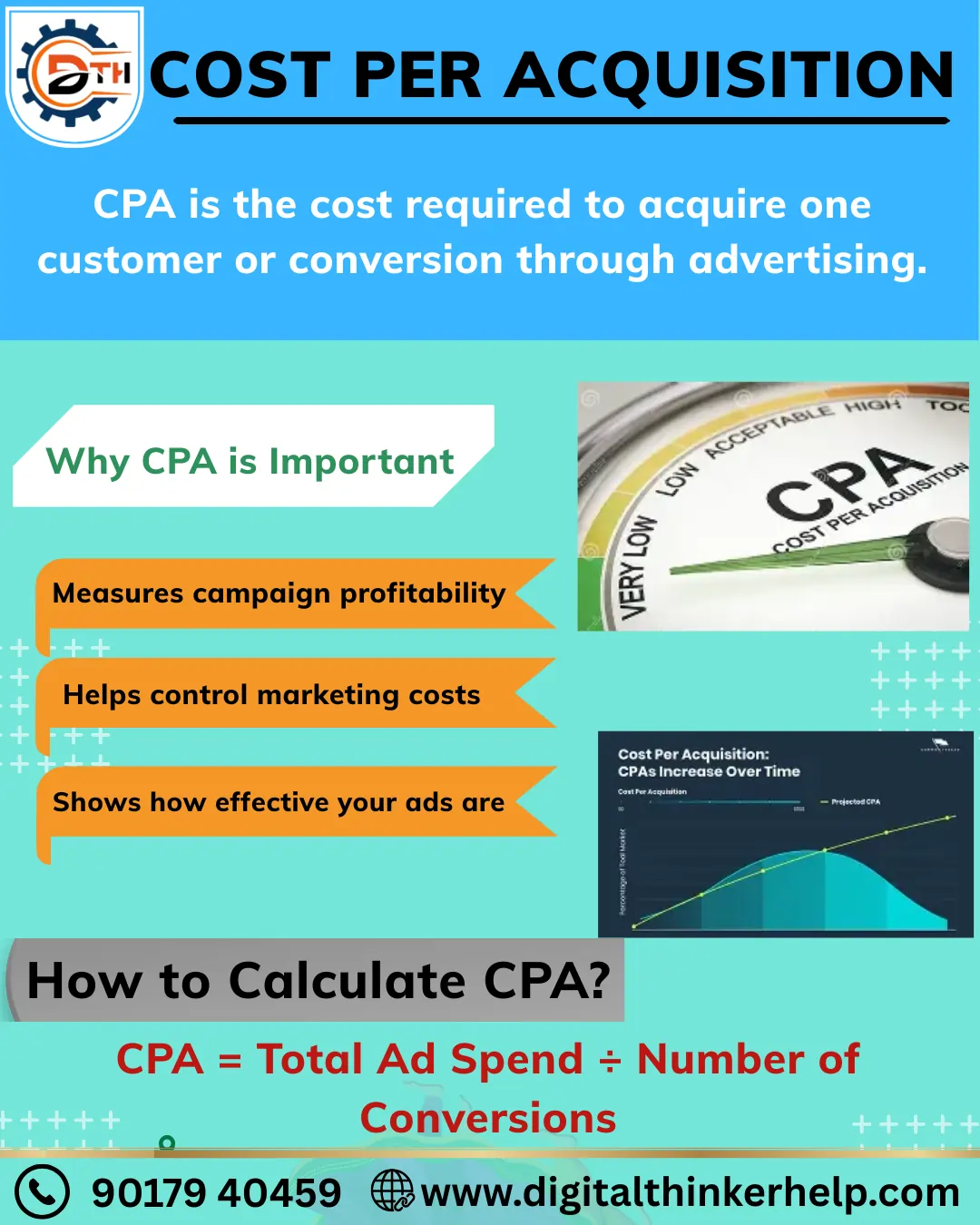
You can think that CPA is the real price tag that helps you clearly see whether your ads are working or not.
What is Cost Per Acquisition? Meaning
It is very simple that Cost Per Acquisition (CPA) means how much money you spend on a specific ad or marketing campaign to get one new customer. It is often using in businesses to measure how much they are spending on ads to bring in real customers.
Also Read: What is Cost Per Mille (CPM) Formula? How to Calculate It
It looks at the full journey from the first time someone sees your ad to the moment they become a paying customer.
CPA is also different from Customer Acquisition Cost (CAC). CAC usually shows the average cost of getting customers from all marketing efforts combined. On the other hand CPA focuses on one specific campaign or channel. So you can clearly see which ad is actually performing well.
Cost Per Acquisition in Digital Marketing – Importance
Cost Per Acquisition (CPA) is important as it shows a business exactly how much money it is spending to get one new customer. It helps advertisers to understand how much of their revenue is going into marketing and advertising.
Companies can clearly calculate their total spending to gain new customers through online campaigns since CPA is a fixed amount per customer.
It clearly indicates whether a marketing campaign is successful is another reason that CPA matters to help measure the success of businesses. If the actual cost is higher than expected then a company sets a target budget for CPA and it means the campaign may not be performing well.
For this reason; the business might need to improve using ads, filter the strategy and focus a better audience to produce excellent output.
How to Calculate Cost Per Acquisition? Formula
There’s a specific formula to use to calculate the CPA, and it’s relatively simple:
Also Read: What is Cost Per Click (CPC)? How to Calculate with Formula
Total campaign cost ÷ Number of acquired customers = CPA
As per this formula, you have to work out the total campaign cost by investing up all the expenses. Here, you can include advertising costs and any other expenses directly have to relating your campaign.
It depends on your business goals. You have to identify and count the number of desired actions achieved through the campaign such as sales, downloads or lead sign-ups.
Cost Per Acquisition Example:
Let’s discuss an example if your campaign cost is $10,000, and you get 100 new customers. Then CPA would be $100.
Which Factors Impact Cost Per Acquisition (CPA)?
Several factors can be considering on influence CPA, including
Target Audience: with the better targeting you can lead to higher conversion rates, and possibly can lowering the CPA.
Ad Quality and Relevance: When ads truly connect with the target audience, they usually get better results.
Bidding Strategies: These strategies decide that how much is spent on acquiring each new customer with the cost-per-click (CPC) or cost-per-thousand impressions (CPM).
Conversion Rate: The CPA will be lower if the campaign performs better.
External Factors: It can also impact CPA such as seasonality, competition and market saturation.
Cost Per Acquisition (CPA)’S Relationship with Other Metrics
CPA is closely related to other performance metrics such as:
Return on Ad Spend (ROAS): ROAS means by each dollar spent on advertising measures the total return is generated. On the other hand CPA focus on the cost to get a customer.
Conversion Rate (CR): If the CR increases then CPA typically decreases and assuming costs remain constant.
Customer Lifetime Value (CLV): Ideally, the cost to get a customer should be less than the CLV to ensure profitability as comparing CPA with CLV is crucial.
CPA Apply On Different Advertising Channels
Cost Per Acquisition is not same for every business. It depends on the strategies you are using for your marketing channel that how you calculate, understand and improve it.
Also Read: Click Rate and Click Through Rate – Difference In Them
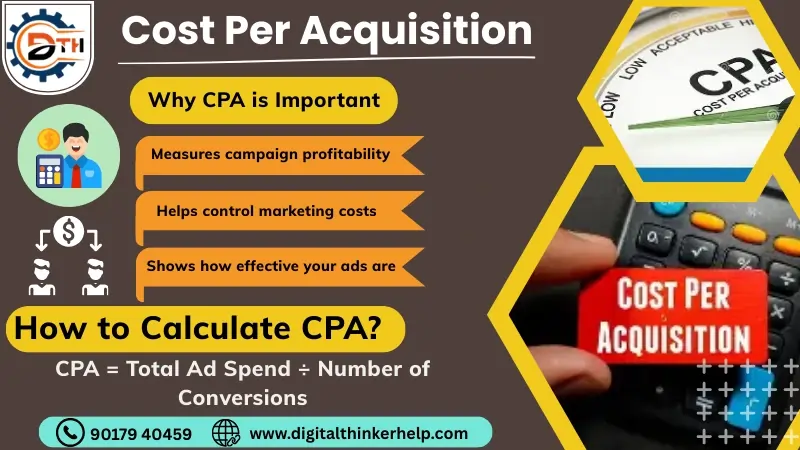
So it is clearly important to understand to building a truly effective multi-channel marketing strategy is a key.
CPA in Pay-Per-Click (PPC) Advertising (Google Ads, Bing Ads)
CPA is most commonly and easily measured where is PPC.
Here is CPA is a direct result of your CPC and your conversion rate. So the platforms like Google Ads have built-in conversion tracking that links ad spend to acquisitions directly.
You can increase your landing page conversion rate by optimizing CPA in PPC involves lowering your CPC (for e.g. through better Quality Scores)
CPA in Social Media Marketing (Facebook, Instagram, LinkedIn)
In case a user might see an ad but not convert immediately. For social media ads calculating CPA is similar to PPC. As a discovery engine it can be more complicated due to the platform’s nature.
Optimizing CPA for social media often involves refining your social media analytics. It understands which audience segments and creative formats drive the most efficient conversions; even if they happen later.
CPA in Affiliate and Influencer Marketing
The CPA model is often baked in when you pay affiliates a fixed fee or percentage per sale they generate in affiliate marketing. The calculation is trickier with influencer marketing. This makes the CPA predictable.
Here you pay a fixed fee for a post or a campaign always. You can calculate CPA by dividing the total fee with the number of sales attributed to the campaign that always tracked via unique discount codes or UTM links. As an acquisition is not guaranteed the risk is higher.
CPA in Content Marketing & SEO: The Long Game
It is most challenging measuring CPA for content marketing and SEO. The acquisitions happen over a long period because the costs are diffuse like salaries for writers, SEO tools and time.
If you want to estimate it you can sum up your total content and SEO investment over a quarter or year then divides it by the number of new customers who originated from organic search.
It is just an estimate but it helps to justify the long-term investment by showing its efficiency compared to paid channels.
CPA for Email Marketing Campaigns
The cost includes the expense of your email service provider and the time or resources spent creating the campaign for email marketing.
Also Read: What is Bounce Rate in SEO? How to Reduce & Check It?
Then you divide this cost by the number of acquisitions generated directly from clicks within the email.
For existing customers CPA for email is often very low. But it should also be considering the cost to acquire the email subscriber in the first place.
FAQs (Frequently Asked Questions)
Final Thoughts
Your marketing efforts by quantifying the cost associated with acquiring a new customer that provides key insights into the efficiency as the Cost per acquisition is an essential metric.
Also Read: What Is Click Through Rate (CTR)? How to Improve It
Businesses can optimize their marketing strategies; manage their budget more effectively and ultimately. It enhances their profitability by understanding and effectively calculating CPA.