
Cost per click or CPC is every marketer should understand that it is a key metric in digital advertising. In simple words this advertising model means that advertisers have to pay each time when someone clicks on their ad. It doesn’t matter that weather click turns into a sale or not. CPC does matters because it has a direct effect on your campaigns that how well and how efficiently perform.
You can figure out when it is needed if your campaigns are actually worth the investment and tweak your strategy by keeping a close eye on what you’re paying per click.
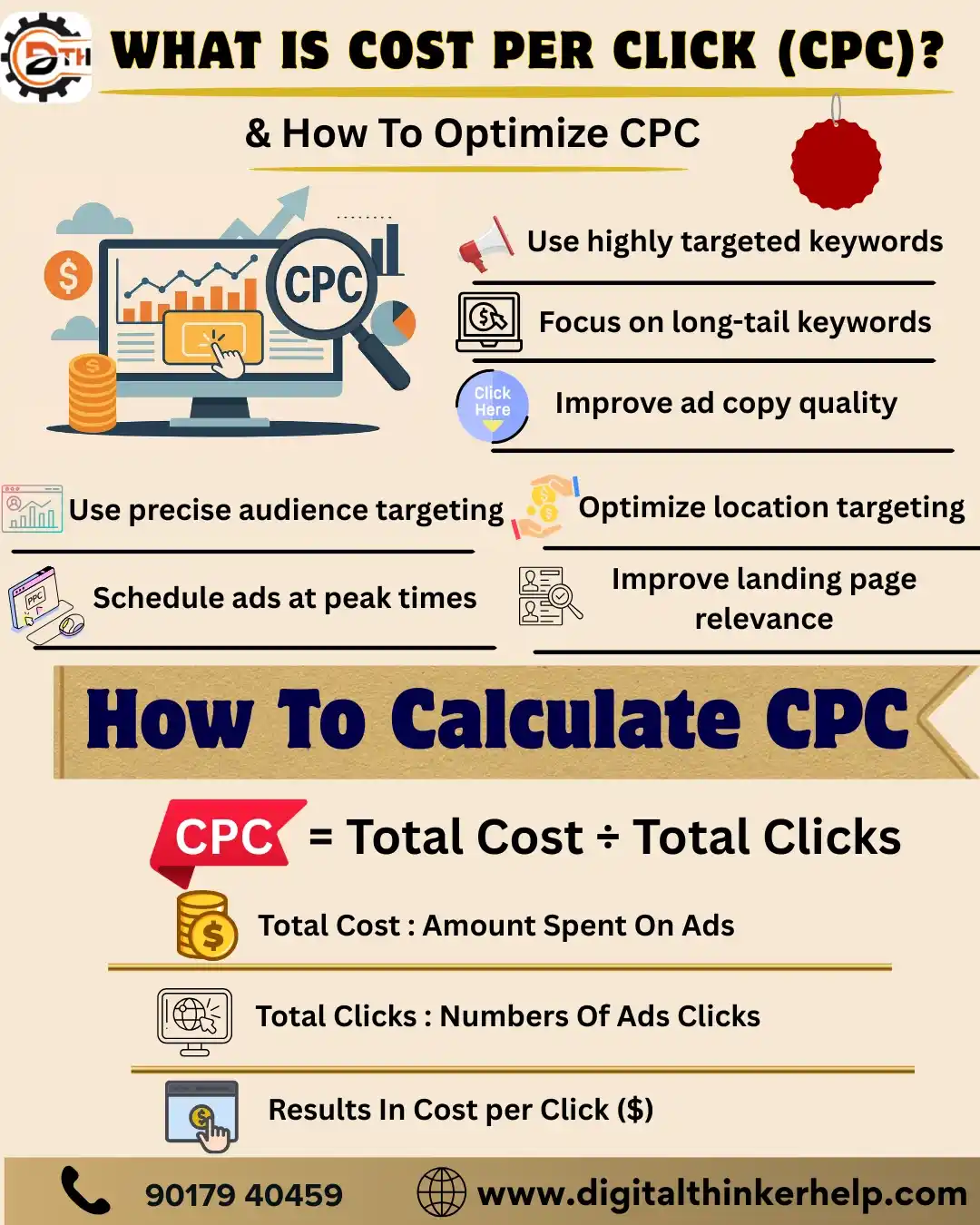
Nowadays knowing how CPC works is essential for businesses that want to get the most out of their digital marketing budget it is highly competitive online space.
What is Cost Per Click?
Basically it means each time the amount you charged when someone clicks on your ad. Cost Per Click (CPC) is an important KPI used in PPC marketing and online advertising The actual cost per click you pay isn’t fixed, though. It depends on several factors, including your quality score, your ad rank, and the bidding strategy you set for your campaign.
Also Read: Click Rate and Click Through Rate – Difference In Them
Your actual CPC can also change based on the type of ads you’re running, whether that’s display ads or video ads. It shows you how well your bid performs and how much you end up paying per click on your chosen keywords are will also affect the audience you target and how competitive.
As well as display networks and social media platforms like LinkedIn and Facebook Ad placement can vary across different platforms including search engines like Bing and Google. You will track your CPC in most cases alongside other key metrics like click-through rate (CTR), cost per action (CPA), conversion rate and CPM (cost per mille) to get a clear picture of your campaign’s overall performance.
What is a Good Cost Per Click?
Generally, a strong CPC means you’re paying less per click than the profit you make from a sale. However here you would still generate more sales than other paid advertising models. A good cost-per-click depends on the product or service you are promoting can be different.
You set an average CPC bid when running a PPC campaign that is the maximum amount you’re willing to pay for each click. Until your set budget is fully spent till then your ads are shown to users and the platform continues serving them.
What is the Average CPC?
As we say that this metric gives you a clearer picture of overall performance. It shows the typical amount you are paying per click across a specific group of ads or keywords. It is also important to understand the average cost per click or average CPC besides the CPC itself.
Average CPC formula is very simple:
Average CPC = Total cost of clicks ÷ Total number of clicks
Simply explain; first take the total amount and divide this with clicks that are the total number of clicks received.
As we have discussed that Average CPC is always changing and can be influenced by factors like your industry, level of competition, ad quality and audience targeting. Since each industry has its own standards so there is not one universal “good” number.
So you are making informed decisions instead of just guessing your way through campaign performance that is why it is important to stay aware of the industry benchmarks.
How Do You Calculate CPC? Formula
CPC Formula
CPC can be calculated by divide the total cost of advertising by the number of clicks received. The formula to calculate the CPC is:
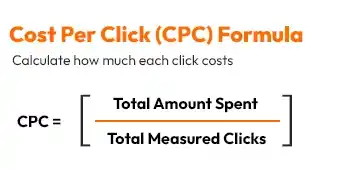
CPC = Total Advertising Cost / Number of Clicks
Example Calculation
Let’s take simple example for your better understanding:
Also Read: What is Bounce Rate in SEO? How to Reduce & Check It?
Advertisers take amount $500 for spending on the ad campaign. After that; they received 1,000 clicks against them; at final CPC is:
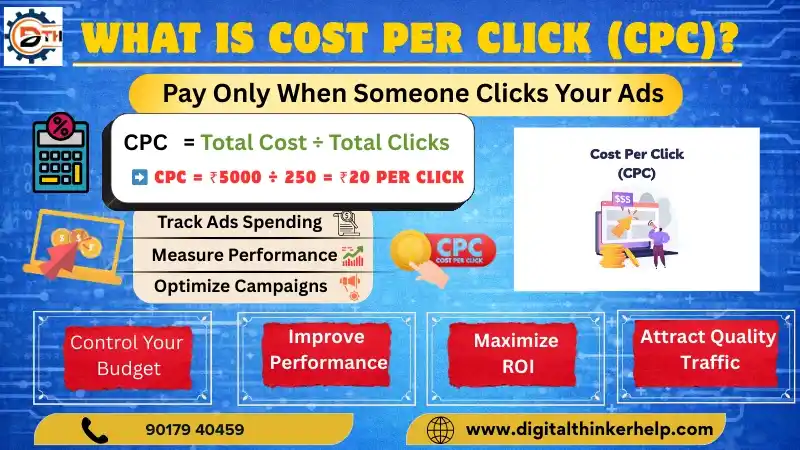
CPC = $500 / 1,000 = $0.50 per click
Benefits of Using CPC
CPC is one of the most commonly used metrics in digital advertising — and for good reason. Here’s why it matters:
1. Control your costs
Just because you only pay when someone actually clicks on your ad the CPC model gives advertisers more control. It helps you to avoid overspending and stay within your planned budget and you can also set daily budget limits.
2. Understand ad performance
It is a strong sign of how well your ad is performing with the number of clicks your ad gets. You can quickly adjust, improve or pause the campaign to prevent wasting money if clicks are lower than expected.
3. Focus on an engaged audience
Clicks show real user interest. Against the impressions which only measure views, clicks that indicate the engagement and the intent. If you are aiming for conversions later in the funnel than it makes them a more meaningful metric.
4. Maximize your ROI
There is no doubt that Pay-per-click campaigns are a major part of online marketing strategies. Knowing exactly how much each click costs and ensuring you are not overpaying for helps to protect your profits and improve your overall return on investment.
Challenges of Using CPC
It is not perfect and there are a few downsides to keep in mind while CPC is definitely popular.
1. Costs can be high
Your total spend can rise fast if your campaign performs well and gets a high click-through rate. It happened especially when you are targeting highly competitive keywords. That is why it is important to manage your daily CPC budget to make sure you are still making a profit by regularly monitor your campaigns and track conversions.
2. Clicks don’t mean conversion
Clicks usually show the interest but they don’t always turn into paying customers.
Also Read: What Is Click Through Rate (CTR)? How to Improve It
Your website or app needs to deliver a great experience to improve your chances of converting traffic. The content should match your ads to clearly communicate your value and make your offer hard to resist.
3. Every click counts (even if you don’t want it to)
You are going to get charged for all the clicks and not just the valuable ones with CPC. It also includes the accidental clicks and even the fraudulent activity. You will still pay for those clicks without seeing conversions in return if someone repeatedly clicks your ad without any real intent.
How to Lower Your CPC?
As B2B marketers are often willing to pay more per click because each customer typically brings in higher revenue per sale.
Normally we still need to make sure that we are being as efficient as possible. Despite it being ‘only’ a leading indicator for B2Bs. It doesn’t mean budgets should be wasted.
Now here are some practical ways to lower CPC and improve the campaign performance:
1. Keyword Optimization: This is first step to optimize your analyzed keywords that are with lesser competition and lower costs. So, you always prefer to long tail keywords that can often help reduce CPC.
2. Ad Quality and Relevance: Next, you have to proceed design appealing and closely aligned with your targeting audience’s needs.
3. Landing Pages Optimization: Once done both steps; you have to need focusing on your landing page. This web page always closed matches your ads messages that provide real value.
CPC in Relation to Other Metrics
CPC is just one piece of the advertising puzzle. We will tell you how to always analyzed alongside other key metrics:
1. Click-Through Rate (CTR)
CTR = (Clicks ÷ Impressions) × 100
Higher CTR means your ad is more appealing and relevant to users that pushing them to make click.
2. Cost Per Acquisition (CPA)
CPA measures how much it costs to gain a customer or conversion:
CPA = Total Cost ÷ Number of Conversions
This metric lets you help to understand the final cost that converting the clicks into your results.
3. Return on Ad Spend (ROAS)
ROAS = Revenue Generated ÷ Ad Spend
With using this metric; you can analyze the overall effectiveness of your campaign. This metric evaluates how much revenue each dollar of ad spends brings in.
Also Read: Click Through Rate Formula: How to Calculate It?
Let’s discuss an example if a low CPC looks good on paper but those clicks don’t convert into sales or leads then the campaign is not truly successful.
Common Mistakes to Avoid
1. Focusing only on CPC: Here, you have to need to keep balance CPC along with conversion rates and overall ROI. This is because; a low CPC cannot be considering as better; if it drives lesser-quality traffic.
2. Ignoring Quality Score: Do notice that the ads with poor relevance or a weak landing page experience can push your CPC higher.
3. Overbidding: If your bidding strategies are smart then it will help you to setting bids higher than necessary can increase CPC without delivering better results.
4. Not Tracking Data: There is you need to use analytics tools to monitor the accurate tracking of clicks, costs and conversions are essential.
FAQs (Frequently Asked Questions)
What is Cost Per Click (CPC) in Digital Advertising?
As told above, whenever anyone makes clicking on their ads then Cost Per Click (CPC) is the specific amount that advertiser pays. It links your spending directly to user engagement and it’s a key metric in PPC campaigns.
A higher CPC can highlight opportunities to optimize your campaign for better results. Although a lower CPC shows that your ad spend is more efficient.
What is the Relationship between CPC and Return on Ad Spend (ROAS)?
For your knowledge, CPC and Return on Ad Spend (ROAS) are essential parameters that are closely link eachother. It can increase ROAS as long as conversion rates stay strong when CPC is lower and your ad spend becomes more cost-efficient.
On the other hand a higher CPC can still generate a positive ROAS. If the clicks result in high-value conversions then showing that cost alone isn’t the full measure of success.
What is the Difference between Average CPC and Max CPC?
Average CPC: Actually, average CPC means specific amount that you paid on per click.
Max CPC: But, max CPC is the highest amount that you’re willing to pay per click (on your bid).
Is CPC the Same as PPC?
This is not exactly same, little bit difference; like as
- PPC (Pay-Per-Click): This woks as the advertising model for any platform.
- CPC (Cost Per Click): Here, you can measure that how much cost is spending on each click.
What is the Difference between CPC and CPM?
CPC = Cost per click
CPM = Cost per 1,000 impressions
- CPC focuses on engagement.
- CPM focuses on visibility.
Final Thoughts
At the finally, you can says that Cost Per Click (CPC) is a key tool for digital marketers in this online advertising. It shows exactly how much you spend each time someone clicks on your ad. If you want your campaigns to succeed then you have be master in CPC is essential.
Also Read: What are Core Web Vitals? How to Improve & Fix Them
CPC isn’t just a number it is like a secret weapon for advertisers. It helps you to control costs, measure ad performance. Even you can decide where to invest your budget. You can navigate the complex world of online advertising like a professional by understanding CPC and adjusting your campaigns based on it.